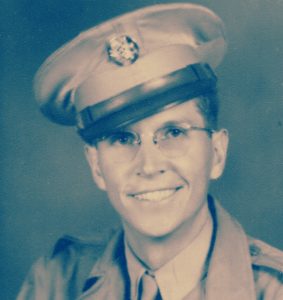
May 23 – June 1, 1944
Tuesday, May 23
A little after midnight, Bill Friedlander (who is in my platoon and is my best friend) came up to my foxhole in the 3rd Platoon and says that our lieutenant has told him to get a man to go with him to carry a message to K Company CP which is about a mile back and to our left. He asked me if I wanted to go. I said, “Sure.” So I woke up my assistant BAR gunner, told him where we were going, and for him to stand guard until we get back. I got his MI rifle and we were off.1
We went to our command post, and there we were given a written message to take to the K Company CP, which was about a mile to our left, and from there to our Second Platoon CP in the next farmhouse to the left of our Third Platoon CP. The Jerries must have been expecting something because they sent up flares almost continually all night, also their artillery was shooting more than usual. Friedlander and I had to hit the ground every few steps to keep from being seen when the Jerry flares went up.
On our way to the K Company CP, we came to a bridge. We are all most ready to go across when someone called to us and tells us not to go across the bridge as it has been mined in case of a Jerry counter-attack. The bridge guard was down in his foxhole smoking a cigarette when we came by him, so he didn’t see us until it was almost too late. Friedlander got mad and told the guard to be damn sure and stay on the job from now on. Ten feet farther and we would have been blown up. We scramble down the side of the canal, wade across, and climb up the other side and continue on.
We find the K Company CP OK, but mortar shells are falling around all most continually. I told Friedlander to hurry up so we could get out of there. He took the message inside, but I stayed outside near a wall. The shells keep coming in and were close, so I lay down flat beside the wall to keep from being hit. The K Company CP was in the basement of the house, and Friedlander was in there about 10 minutes. He comes out, and we are about 1⁄2 way back to our area when Friedlander remembers that he didn’t tell them all of the message. We go back and it only takes a minute this time.
We start back, but in one place there is a tree down across the road, and while Friedlander and I are trying to get through it, we hear enemy shells coming in. I made a dive for the ditch, but the shells start exploding before I get to the ditch. Friedlander lays flat in the road. After a minute or two the barrage lets up a little. I asked Friedlander if he was hit. He said, “No, are you?” I said, “No.” He said, “Come on, let’s get out of here.”
I look back and the shells are really blasting the area we have just left. While we are waiting, Friedlander tells me that while he was at the 2nd Platoon CP he heard some officers saying that we are going to make an attempt to break out of the Anzio beachhead at dawn. We decide not to say anything about it to anyone, but when we get back to our foxholes, some soldiers from the 3rd Division are digging in an anti-tank cannon about 20 feet in front of my foxhole. Several others of the 3rd Division soldiers are digging in beside and behind my foxhole. One of the anti-tank boys is from NC, and we talk about home some.
About daybreak, our artillery opens up with a terrific barrage.2 I sat on the back edge of my foxhole and fired my BAR toward the German lines. The enemy guns answered pretty heavy. I get into my foxhole. After a while, I crawled out of my foxhole to have a look. There is a farmhouse or barn (it was almost completely torn down) about 100 yards in the left front of my position. I saw 4 or 5 Jerries running down the road toward the buildings. They were about 100 yards away. I fire a whole clip (20 shots) at them with my BAR, and they all disappear. I don’t see any more of them. I keep firing at anything that moved or looks suspicious, or looks like it might be a hidden gun position in the mountains, to give the 3rd Division support for their attack. At Anzio, the Germans had the high ground and surrounding mountains. All of our movement had to be at night or we would draw fire.
When the enemy artillery lets up some, I fired so fast my BAR got so hot I could hardly touch the barrel. It was raining a little, and when a drop of water hit the barrel it dried up right away. I was firing toward the enemy lines to give support to the 3rd Division troops who were beginning an attack.
The 3rd Division infantry boys moved out ahead of us, and I have to stop firing. The anti-tank boy from NC gets in my hole with me and stays with me until over in the afternoon. He has to crawl out every little bit to help fire the anti-tank gun when their observer calls in a new target.
Two of the 3rd Division tanks come right by my foxhole. There were a lot of 3rd Division tanks, and the Krauts on the mountains threw everything from 20mm to 88mm cannons at them, especially a lot of mortars and some “screaming meemie” shells.

Several of the shells came close to my foxhole and throw dirt in on me. My foxhole had sandbags on top of it, and I laid my BAR on the sandbags when I had to fire it, and when enemy shells came in I lay as low as I could get in the bottom of my foxhole, but I would leave the BAR on top on the sandbags ready to fire when the enemy shells let up some.
One large German shell landed on the edge of my foxhole, [and] caved in one side of it. I felt like I bounced, and had dirt all over me, but I wasn’t hit. When the shelling let up I retrieved my BAR, and I found that a piece of shrapnel had cut one of the bipods (legs) that were at the end of the BAR barrel about half in two. The leg stood out at an odd angle, and I tried to straighten the leg, but I couldn’t. Another piece of shrapnel hits my canteen that is sitting on a little dugout shelf inside my foxhole, and the water runs out. I get another canteen that one of the fellows that was hit left. I kept trying to straighten the hit BAR leg and it finally broke off.
The 3rd Division attack appeared to be going well, but the Germans were still throwing shells at us from their positions on the mountains that surround Anzio. About 3 o’clock, I see a shell hit center on Goose Castleman’s foxhole about 40 feet from my foxhole. His foxhole has a layer of sandbags on it, but one fellow is killed and another wounded, but Goose was only shook up a bit. A big shell hit right beside Shorty Von Zell’s foxhole and bounces him out, but he isn’t hurt and crawls back into his foxhole. His foxhole is about 20 feet from mine.
Just before dark, our company pulls back and we walk about 4 or 5 miles to an open field.3 We were given some 5-in-1 rations.4

Wednesday, May 24
We stayed in the field until about 3 pm. About 2 pm, the Germans saw us and threw some air bursts (anti-personnel shells that exploded just before they hit the ground) and sprayed the ground with shrapnel over the field where we were, but no one was hit near me.
We moved down the road towards the mountains about 2 miles and attacked a strong point that another company failed to take this morning. We passed several dead Germans. Once the column stopped, and Friedlander and I were right beside some dead Germans, Friedlander said, “Cox, there are the kind of fellows we are fighting.”
We moved forward slowly, and moving through a field we were fired on by machine gun fire, also a German tank fired some 88s at us. The tank and machine guns were behind a canal bank. We were close, and I could hear the tank motor a couple of times. We were kept pinned down in the field until dark. I dug a small foxhole while laying down flat.
After dark we reorganized and attacked again. We move up slowly most of the night without meeting any resistance, although the Jerries continually kept sending up flares.
Thursday, May 25
A little after midnight there is a shot right behind me. They pass the word up that it was an accident. One of the soldiers, about half asleep, was carrying his pistol in his hand and it went off.
The firing in the attack is up some distance ahead of us. My buddy Reynolds is near me, and once when our column stopped for about 20 minutes, he said “Let’s sing some, Cox.” When we were back at Anzio we were in the same foxhole some, and we would sing together softly, mostly westerns and country songs. I say, “OK.” So we sing together right low while waiting for the order to move on in the attack. Some of the boys near us think we are crazy. They say that we had better sing now though because we will all probably get our ass shot off before morning.
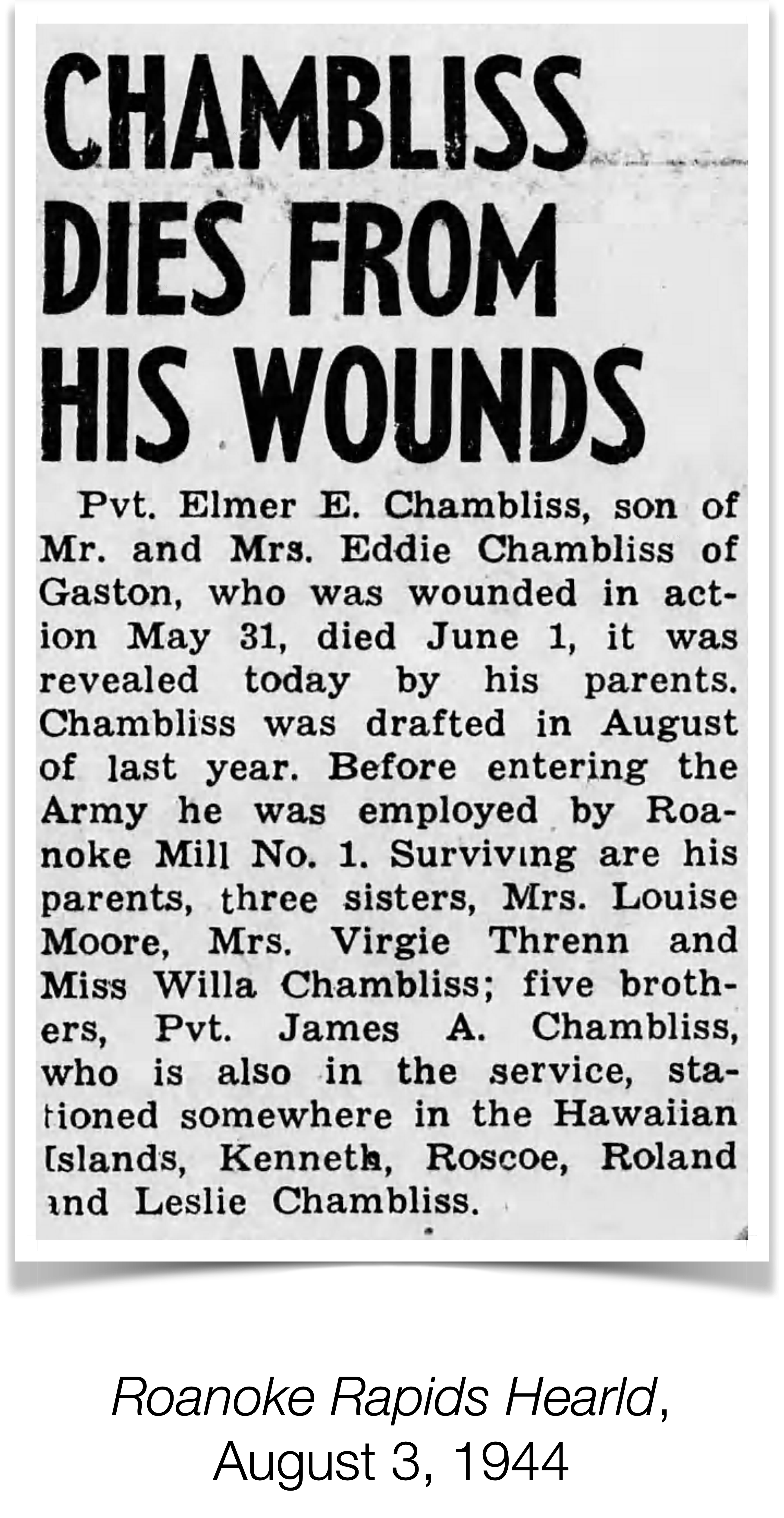
About 2 am, we reach our objective, a section of the Anzio-Rome railroad.5 We push past the railroad about 200 yards to a canal and dig in without any resistance. K and L Companies, which were attacking with us, made contact with us and dug in on the canal left and right of us forming a line. K and L companies came by my position in single file, and I looked for Chambliss, Wimp Crider, Red Hendricks, and Leon Boatwright (we were in basic training together), but failed to spot them it still not being daylight. I had to dig in on the flank of our position being the BAR man. About daylight, American 105mm artillery spots us and opens fire thinking we were Germans, but we had chased the Germans out of that area during the night. We quickly get on the other side of the canal bank. Their shots were just a little short though and, after a few rounds, they recognized us or the company commander made contact with them on the radio, I don’t know which.
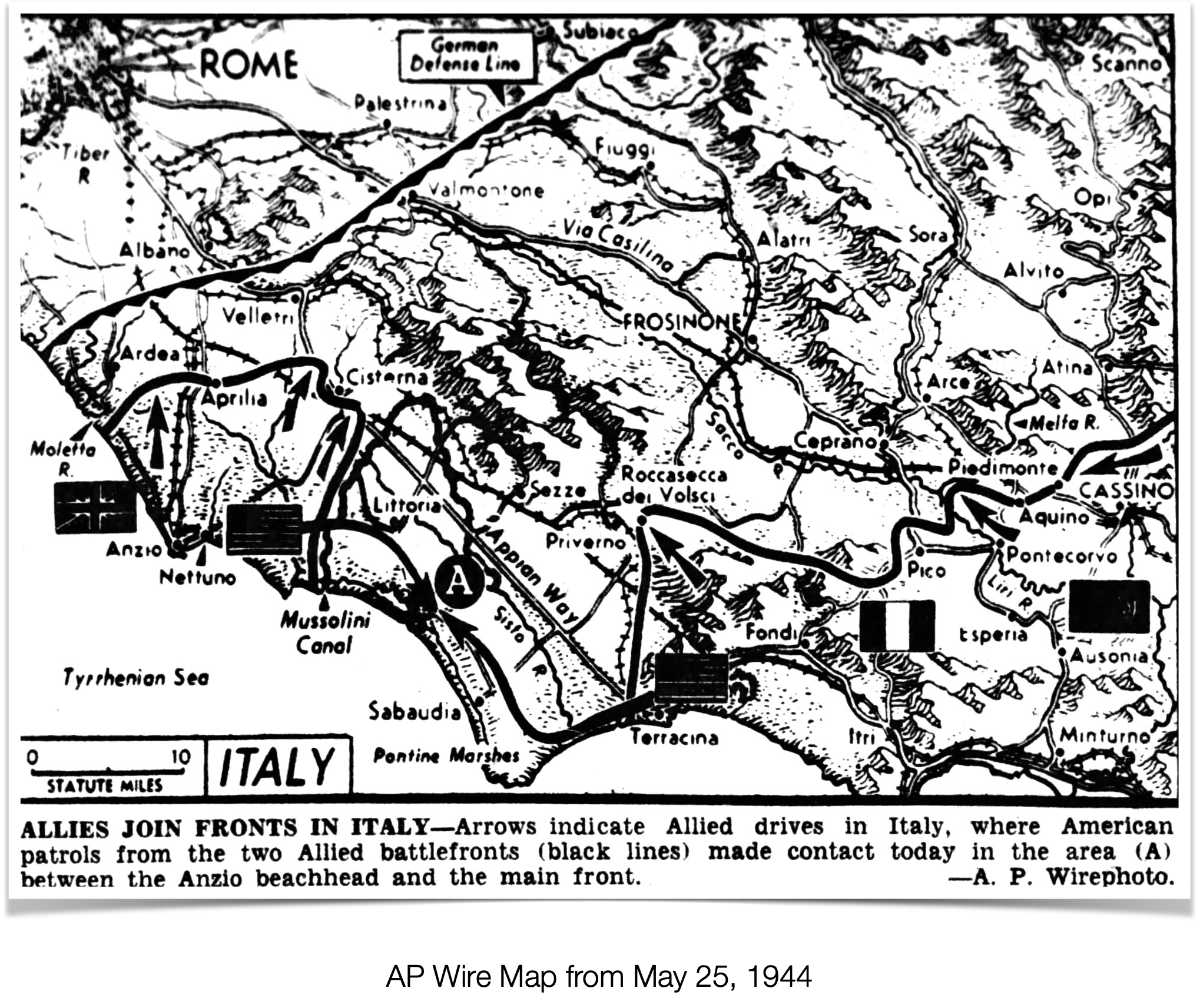


Soon more infantry and tanks move up to our position and on past us toward the mountains. By noon it looks like the whole American army is coming by. When we see the “Long Tom” 240mm guns come by, we are sure that the Krauts have pulled way back as the “Long Toms” usually stay some distance behind the front lines.
Several of the fellows go back and search some dead Jerries that we passed last night, but Reynolds and I don’t go. We get some water from the canal, wash our faces, and eat our K-rations. I drink a can of condensed milk that I received in the mail and have been carrying for a couple of days. About 1 pm, we pull back to the fields where we started the attack the day before and get our bed rolls. We get our mail there, two days K-rations, and Reynolds and I get some good cool water out of a well at an Italian farmhouse. We found some wire, and let our canteens down into the well to get the water. We heated some coffee on a Coleman stove. About 9 pm, we load on trucks and start somewhere, we don’t know where. The boys are in a good mood and tell jokes and laugh a lot.
Friday, May 26
We have been riding about 4 hours, and it is about 1 am when I see some shells landing ahead of us. Soon the trucks, which only have dim lights on, stop and we get out and walk about 2 hours. Several times we had to get in the ditches because the enemy shells were landing so close. I almost couldn’t make it carrying my bed roll, BAR (the BAR weighs 21 pounds), BAR ammunition, gas mask, field pack, and 6 boxes of K-rations. We stop in a field about 3 am, and I unroll my bedroll, spread the blanket in a shell hole, and go to sleep. Everything near us is pretty quiet.
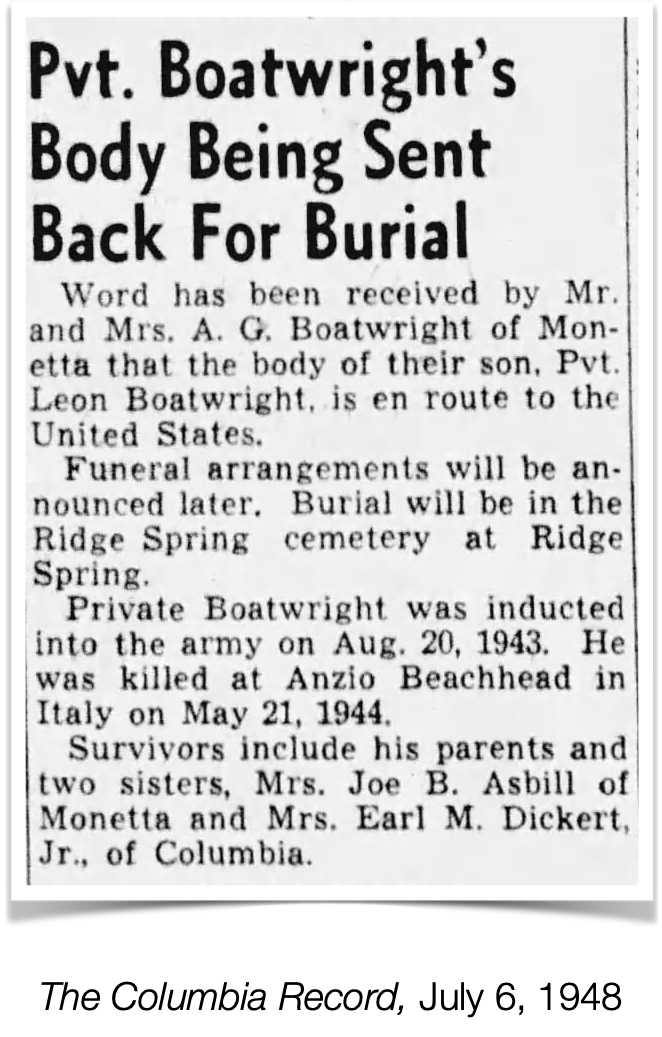
About daylight, the word is passed around to get ready to move out. I roll up my bedroll and get ready. K and L Companies come by, and I see Cramer L. ”Wimp” Crider, Chambliss, and Red Hendricks. They are to lead the attack with I Company in support. I find out later that in this attack Chambliss is killed by a mortar shell, Leon Boatwright is killed, Wimp Crider is creased in the head by a bullet, and Red Hendricks is hit in the leg with shell fragments.6

We throw our bedrolls on a pile of bedrolls as we go by it. We come by a German graveyard of at least 100 graves with white crosses on each grave. We go by several batteries of our artillery which are firing at enemy positions ahead of us. We move on in single file slowly, often having to hit the dirt because of enemy shells coming in. Once we were pinned down by enemy machine gun fire. The fellows ahead cleared him out and we moved on slowly often stopping for an hour or two in one place. We pass several dead Jerries and met several walking wounded Americans going back to the aid station. The artillery seems to fire continually.
At dark much of the artillery stopped firing. And at dark, we moved ahead in single file with scouts out in front of us. When the army moves into enemy territory, they always send out scouts or a point ahead to keep from being ambushed. When a small group moves, the point may be a soldier or two. But when a large group moved into enemy territory, the point could be several soldiers and even tanks. We moved slow, often stopping an hour or two at a time. I tried to sleep some when we stopped. We moved through thickets, fields, and gullies.
Once, on a road near a house that seemed to have been a factory, we came across a place where dead Jerries were piled on each side of the road where the Americans ahead of us had pulled them out of the road so we could get through. There were legs laying around, heads with no body, and guts and blood all over the road. It smelled awful, and I almost got sick. There were high banks on the road there, and apparently, the Germans had used that road for a staging area, and American artillery gunners had hit them there. We moved on without meeting any resistance. Once, about midnight, we stopped for about 2 hours. I went to sleep using my helmet as a pillow.
Saturday, May 27
We were in support of the attack, and about 4 am we stopped and dug in along the edge of a vineyard. They brought our mail up about daylight. At daylight, my assistant gunner took his turn at sleeping. About an hour later, before my turn to sleep came, the enemy shells were coming so close we decided to leave our holes and take shelter in a deep gully nearby. There was water in the gully, but it gave better cover than our foxholes. We stayed in the gully until about noon. Enemy shells were coming in most of the time, but no one near me was hit.
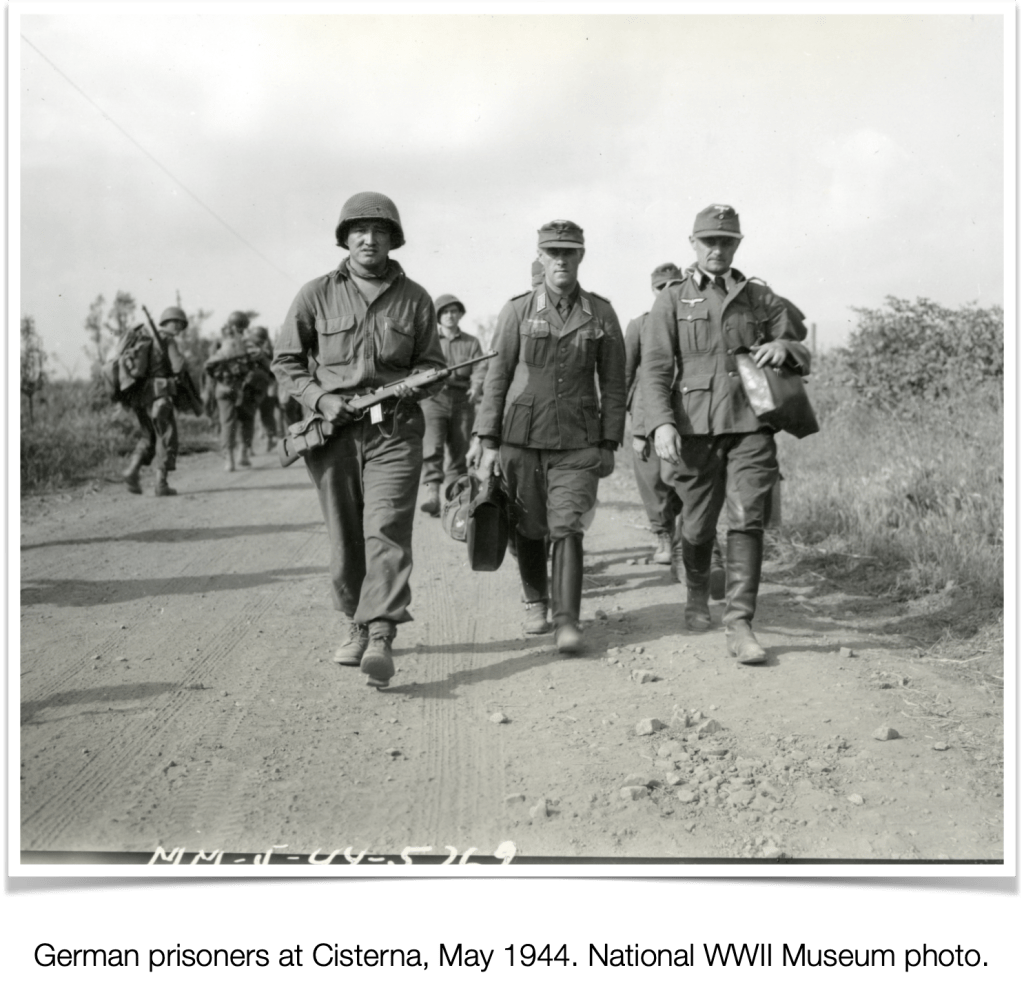
About noon, we moved out slowly in single file about 10 yards apart. (We usually moved out about 10 yards apart so if enemy shells hit us it would not take so many soldiers out.) Soon we were fired on by a machine gun, but it was cleared out before long and we moved on. We came to a road and, while we were waiting, a German stepped out in the road near me. He had no helmet and his hands were over his head, and an American soldier was guarding him. The guard asked me where the 3rd Battalion CP was, but I didn’t know. The German was a young fellow with blond hair. They moved on down the road.
We left the road as they were shelling it too much, and went up a ditch. We came to a well, and some of us got water. We were ordered to dig in on the edge of a field. About the time we got dug in, we were ordered to move back about 200 yards to a vineyard. Some of the fellows dug foxholes, but I found a Jerry foxhole and stayed in it. There were a couple of dead Germans in the vineyard, and a German rifle and some ammunition in my foxhole. I moved them out of my way but did not mess with them. I slept about an hour, and then read some letters. About dark, we started forward to where our forward positions are. There we lay in a ditch until about midnight.
Sunday, May 28
A little after midnight we were ordered to attack with I Company in the lead (I am in I Company). We start out, but before we contacted the enemy, we were called back and the attack was called off until daylight. We had been losing several officers, and probably a new officer ordered the night attack. I get some much needed sleep laying in the ditch with my equipment on and my BAR in my lap. Before daylight, we get some more K-rations, some bread, and water.
At daylight, we start the attack with I Company in the lead. I Company had been in support in the last attack. We were going through a vineyard when three Jerries with camouflaged uniforms grabbed a couple of the fellows in the 1st Platoon and got away with them in the confusion. After that, we kept careful watch.
We moved forward slowly, several times we were pinned down by enemy machine gun fire, but our machine guns, mortars, and artillery managed to drive them back each time. About 10 am, an 88 shell landed between Friedlander and the man in front of him. Friedlander and the other fellow were covered with dirt, but not hit. They were shocked and had to be sent back to an aid station. The boy in front of Friedlander was hysterical and crying when they brought him by me. Friedlander was in front of me, so when he and the other guy went back the sergeant passed the word back, “close it up,” so I moved up to take their place in the line.
We advanced about 100 yards farther and ran into a strong bunch of Jerries entrenched on a ridge behind a rock wall. (Most gardens, some yards, and fields in Italy were surrounded by rock walls.) The artillery threw in a barrage, and about 3 pm we assaulted the ridge firing our small arms. They returned the fire so heavy that we had to fall back though with several casualties. My squad fell back to a creek bed. The water was a little muddy from the shells, but I was about out of water, so I dipped a little creek water into my canteen. About that time a water snake slid into the water just above me. I added an extra purifying pill,7 but since I wasn’t given any clean water until the next morning, I had to drink some of the creek water in my canteen. We stay in the creek bed until dark while our artillery gave the Jerries another going over.
At dark my squad is ordered to advance to a bridge near the German positions and guard it so the Germans couldn’t blow it up. We got there OK and dug in, but the Jerries heard us and fired at us some. We didn’t fire back as that would give our position away. They didn’t make any attempt to blow up the bridge except by artillery. About midnight a group of us went back for water and rations.
Monday, May 29
After the rations and water was distributed I let my assistant gunner sleep first while I stood guard. After about 2 hours I woke him up and lay down in my foxhole, but before I went to sleep I noticed that my assistant gunner lay down and was asleep again. I was so tired, sleepy, and discouraged that I just went to sleep anyway. Luckily the Jerries didn’t come while we were asleep. I slept about an hour and then just before daylight, our squad leader woke us up and said we would fall back to where the rest of the company was.
When it got light enough to see we attacked the ridge again without any artillery barrage. This time we made it with only a few casualties. One fellow near me got a bullet in the leg. Near the top of the ridge, a machine gun kept firing toward us. Some of the fellows returned the fire and kept him pinned down while we crawled toward him. As soon as our Sergeant Lemkie was near enough he tossed in a couple of hand grenades and gave them a burst at close range with his Tommy gun.8 He hollered, “Come out of there, you son of a bitch.” I raised up and looked, and saw four Jerries come out of their foxhole with their helmets off and hands up. They were saying, “Comrade, Comrade, Comrade.” The sergeant assigned one fellow to take them back to the rear.
Soon German mortar and artillery fire was coming in pretty heavy, so we took shelter in a draw9 while the lieutenant and three or four other men scouted around. After about an hour, he came back and we moved forward by a wrecked factory and an old rock quarry with only some mortar fire to bother us. There were several dead Jerries on the ridge and near the factory. I picked up a knife in a foxhole on the ridge. We stayed behind a ridge until about 2 pm, then our artillery threw in a heavy barrage on the ridge before a small Italian town (LaNuvio or some name like that).10
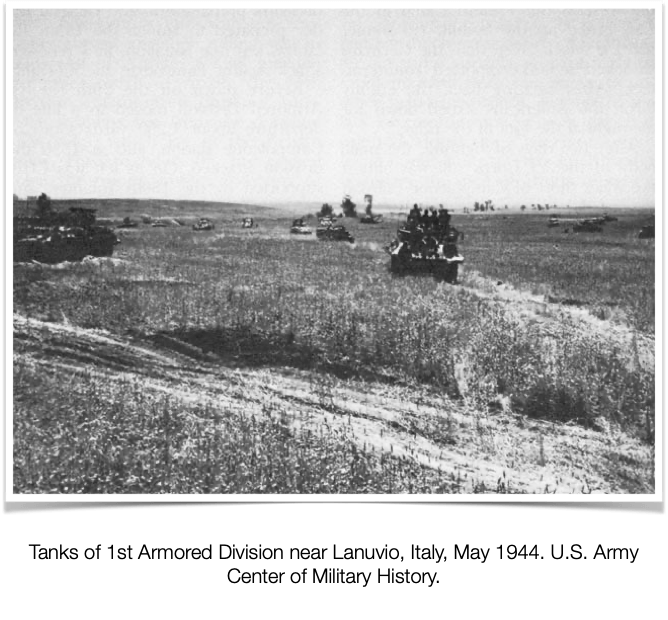
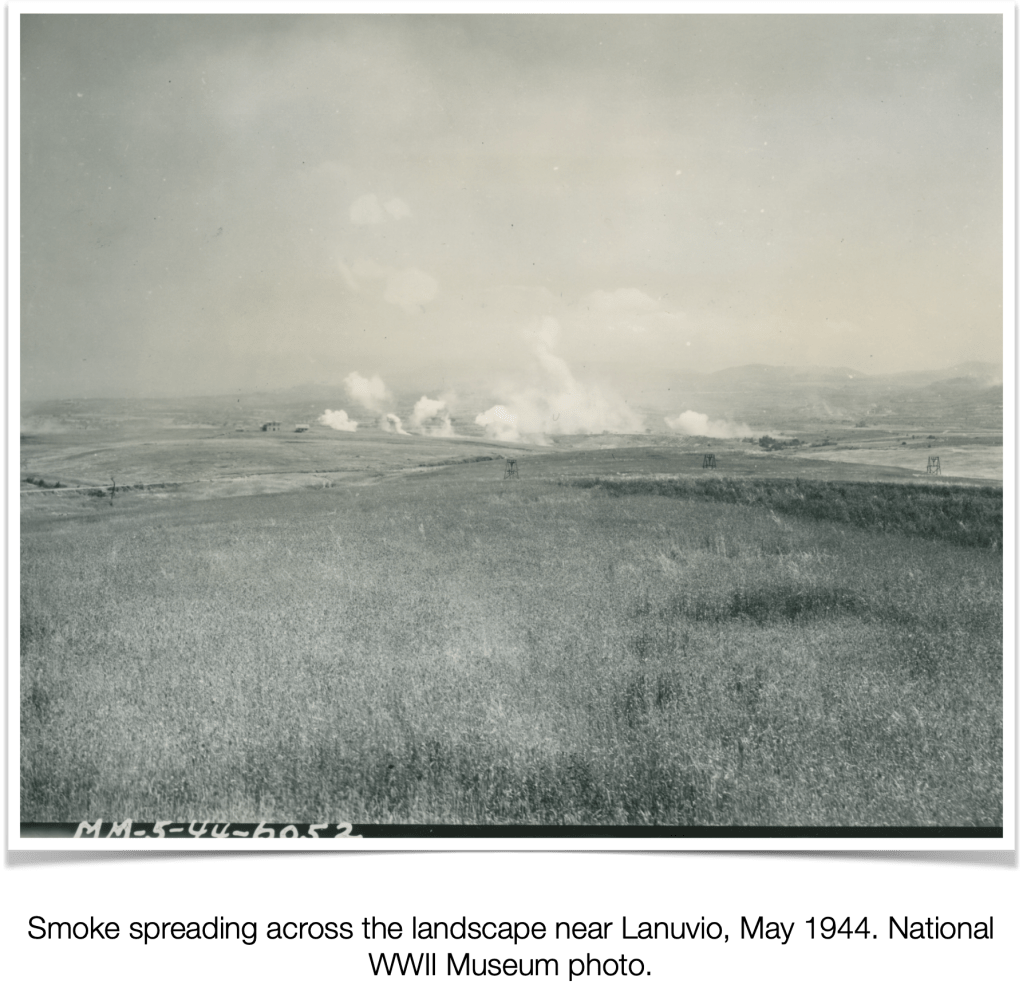
Then our artillery threw in some smoke shells to cover our advance, and we started out across a large field. This field had small grain in it about 6 or 8 inches high. We had some tanks and armored vehicles supporting us. We got about halfway across the field when the enemy machine gun and mortar fire became so heavy we couldn’t advance any further.
The Germans threw 88s and other heavy artillery at the tanks and armored vehicles. Our tanks were firing at the Germans also. Two of the American vehicles were knocked out, and the rest of them retreated back behind the ridge we started from. Our tanks kept firing from behind the ridge.
We were pinned down in the field. A machine gun and a couple of snipers were firing at my squad. We all hit the ground, but I happened to be on a spot of high ground when they started firing directly at us. I was laying down, but apparently, a sniper could see me. He fired a couple of shots that knocked dirt in my face, so I made a dash for a shell hole that was near. They fired at me while I ran, but I made it OK, but there was a dead Jerry in the shell hole. I lay down beside him, but he had dried blood all over his face and body and he smelled awful. (One of the hardest things to get used to on a battlefield is the constant smell of death).
After a couple of minutes, I decided to make a dash for a ditch nearby. I get up and start, but they fire at me so I hit the ground, roll over a couple of times, and get up and run the rest of the way. I made it to the ditch, but I don’t see how. I was separated from my squad. I called to Friedlander and [Sergeant] Fly,11 but no one answered. (Later I learned that the Germans were firing from behind a rock wall. Fly got two bullets in the leg and my squad had moved back over the ridge.)
I was alone and in no man’s land. I lay in the ditch the rest of the afternoon looking to see if I could spot a Jerry. I saw two men about 100 yards ahead, but there was so much shell smoke and dust between us that I couldn’t tell if they were Jerries or not. I didn’t fire and they soon went out of sight. Our artillery began firing again, and the Germans kept dropping mortar rounds in the field. Some landed close to me. Our tanks and the German tanks began firing at each other across the field. The shots from both sides were going right over my head. I was safe enough from the tank fire, but the noise was terrific. Once, I was startled when I saw someone scrambling down the ditch toward me, but I soon saw that he was an American. He said he had volunteered to go see if anyone was still alive in one of our tanks that had been hit. I could see the knocked-out tank, but I didn’t see him anymore.
I was still separated from my company and was in no man’s land. About sundown, I decided that I had better get back to our lines someway before dark or our troops might shoot me for a Jerry in the dark as I didn’t know our password for tonight. I started back keeping low, but a machine gunner fired at me. The bullets came so close that I could feel the wind of them, and it sounded like the guns fired in my ear. I hit the ground and lay still. The machine gunner fired a few more bursts in my direction, but they went over my head. I lay still for a while, then I crawled the rest of the way back over the ridge. It was about dark by the time I got back over the ridge.
I didn’t see anyone, so I went down a ditch to a deep draw. I ran into a couple of fellows there that were looking for their outfits, so we went down the draw together. We met some 1st Armored Division boys moving up. They wanted to know where the Jerries were. We told them that the Jerries were on the ridge across the field. A little further down the ditch, we come across some fellows from the 1st and 2nd Platoons of my company (I am in 3rd Platoon of I Company). I stop there and the other fellows go on looking for their outfits. (In a battle things often get mixed up a bit).
The Jerries throw an artillery barrage at the draw, and I get in a foxhole with one of the fellows in the 1st Platoon. After the barrage lets up a bit, the lieutenant says he is going to look for our company command post. We go along. The men in the 1st and 2nd Platoons say that a lot of the men in their outfits have already been killed or wounded, including all the lieutenants except this one and he has a groove across the bridge of his nose where a bullet creased him.
We haven’t gone far when we come across Friedlander. He was only shook up by the shell that landed near him. I go with him and we locate the rest of our squad. Sergeant Fly and another fellow have been wounded, but the rest are OK. We go over to the rock quarry and find the rest of my company there.
About 30 minutes after we get there our platoon was getting ready to start on a combat patrol in the dark. We go all the way across the field, where the fighting was today, in the darkness. At the edge of the field, we set up a line of machine guns to cover us. At the far end of the field, we go up a path through a vineyard. We are in single file, and I am the 5th man in the column. There are German dugouts along the path. We go up the path slowly and quietly until someone hollers at us in German. We stop and lay down in the path. I slipped the safety off my BAR ready for action. The Jerries talk and jabber over there for a while then everything gets quiet again. Captain Kelly says he believes we are almost surrounded, and to pass the word back that we are to pull out single file like we came in. We got out and formed a line in case of an attack. Later we moved back to where we started.
Tuesday, May 30
At the rock quarry, we dig in behind a bank of dirt and go to sleep. It gets too hot to sleep about 9 am, so Reynolds and I get our canteens and go back to look for some water. We find a hole of dirty-looking water near the quarry, but one of the soldiers there said, “There is some good water about 50 yards farther over, but look out for the German over there in the cave. He is sort of sick”. “What is the matter with him,” I asked. “He sort of got his leg shot off,” the fellow said.
We went over there, and Reynolds went in and looked at the wounded German. There were bloody bandages laying around the cave entrance, and it smelled so bad that I didn’t go in. Reynolds said the Jerry looked like he was about dead. We got our water and went back over behind the bank, and I shaved for the first time in a couple of weeks. We ate some K-rations, and I cleaned my BAR.
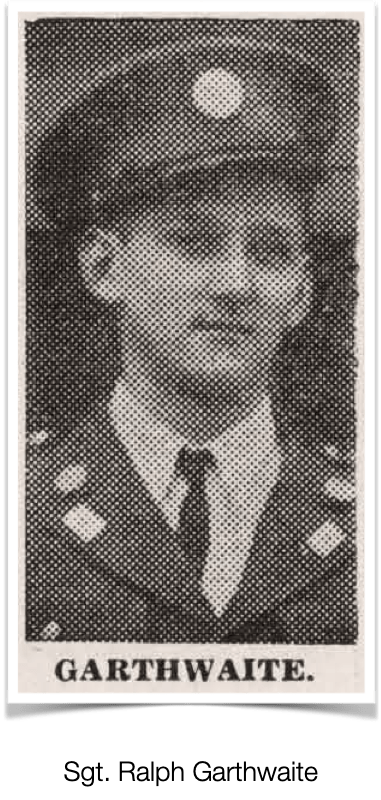
We got a new lieutenant for our platoon leader today. He hasn’t seen any action vet. He has just arrived overseas and came up with our ration truck last night. Sergeant Garthwaite12 brought him around and introduced him to all of us this morning.
Our artillery has been firing heavy most of the day. We were able to get the German position from our combat patrol last night. About 1 pm we started another attack across the field, but we had L Company with us this time. We get about halfway across before the shooting started. We tried to go on, but it was suicide. We had to take cover. I got in a small ditch. Shorty Von Zell, our radio man, was sitting near me trying to get our battalion command post on the walkie-talkie when a bullet clipped the antenna off while he was talking. He got so excited he could hardly talk.
The new lieutenant crawled over and tried to get the battalion on the radio. After a while, they answered, and he talked to them a while. I didn’t hear what they told him, but he gave the radio back to Von Zell and got up and said, “Come on men, follow me.” I hesitated to get up, and he went about 15 steps when a machine gun opened up on him. He fell, but shouted, “I’m hit men, but keep on going.” I didn’t see anyone else get up. He had two bullet holes in the leg. We didn’t get up because we had been trying to go across that field for two days, and the Germans that were firing at us were behind a rock wall. The lieutenant was brave, but not combat wise.
Often the battalion commander will tell the company commander that the company on your left or right is a half mile ahead of you. Close it up. The fact that we had to go across a heavily defended open field made it difficult to advance. After a while, the medics came up and got the lieutenant. We lay in the field until dark.
Before dark our tanks and armored vehicles pulled up over the ridge and gave the Germans a going-over. The Germans responded. They were firing over us in the field. Our tanks would pull up on the ridge, fire a few shots, pull back and over to another place, and fire some more to keep the Germans from zeroing in on them. The Germans threw 88s and heavy stuff at our tanks. I saw one of our tanks about 75 yards to my left get a direct hit with a large German shell. After the smoke and dust cleared, I saw that the side of the tank that was next to me was caved in. The tank didn’t burn, but I didn’t see any of the crew come out.
When the big guns fired it would almost lift me off the ground. I almost became hysterical, but forced myself to be calm. I tried holding my hands over my ears, but it didn’t help much. At dark, we pulled back to the rock quarry, and my assistant gunner and I had to stand guard. I let my assistant gunner sleep first, and then I slept. We stood guard in two-hour shifts. The Germans kept throwing shells around us all night, but I didn’t have any trouble sleeping when the time came.
Wednesday, May 31
We came in from guard duty just before daylight. I sleep in a hole behind the ridge until about 8 am when it gets too hot. I cleaned my BAR, ate some K-rations, filled my canteen, and talked with the fellows some.
About 10 am, the command decided to send a patrol into the German lines to locate gun emplacements. My whole squad is to go, and we have orders to go until we draw enemy fire. They plan to locate the enemy guns that fire at us. None of us are anxious to go as it sounds like a suicide mission. Also, we have been attacking the German positions here for two days, and the Germans have thrown about everything they have at us. Where was our command then?
We go up a ditch at the side of the field for about 200 yards without anyone shooting at us. We move slowly and are watchful. I notice that there are empty German foxholes along the left side of the ditch and a vineyard on the right side. We keep moving up when suddenly a German soldier in a foxhole near me stuck his bare head out of one of the foxholes and smiled at us. As soon as he noticed that we were not Germans, but Americans, his smile faded and his head quickly disappeared into his foxhole. We ignored him and continued on.
Soon a machine gun fired on us, and mortars began falling. We quickly moved into the vineyard, and when the American shells started coming in, we began crawling as fast as we could down the rows. The rows were ridged up several inches, and this gave us protection from the machine gun. But the German mortars fell among us, and also the American artillery began firing, and some of the rounds came very near us. But we got back to the quarry without losing anyone.
About 1 pm our command decides to attack again. We have four platoons and one heavy weapons platoon. I am sure the colonel has told our officers to close it up. Our officers decide to send one platoon (about 50 men, four 12-man squads, make up a platoon, however, these platoons had lost several men and were short-handed) up each side of the field with two platoons going through the field with the heavy weapons divided up among the other four platoons. My platoon goes through the field. This is the third day we have tried to go across that field. We get into the field a ways when the Germans opened up with machine guns, snipers, and mortars. They were firing from behind a rock wall. I lay in a place where a shell had landed. The shell hole isn’t big enough, but it helps. Wheat in the field is green and about knee high. This helps give some cover. We lay there about two or three hours while the Germans shoot mortars shells and machine gun bullets at us.
The medics, carrying Red Cross flags, come into the field to get the wounded. One soldier near me had part of his face blown away. He was bloody and was saying, ”Oh God, Oh God.” The medics carried him out piggy-back style. The German snipers and machine gunners do not shoot at these medics, probably because they were carrying Red Cross flags. While we were pinned down in the field, our dive bombers hit the rock wall and gave the village of LaNuvio [Lanuvio}, our objective, a heavy bombing. It was a pretty sight to see our planes drop their bombs and pull out of their dive. The Jerries shoot some ack-ack at the planes, but none are hit that I see.
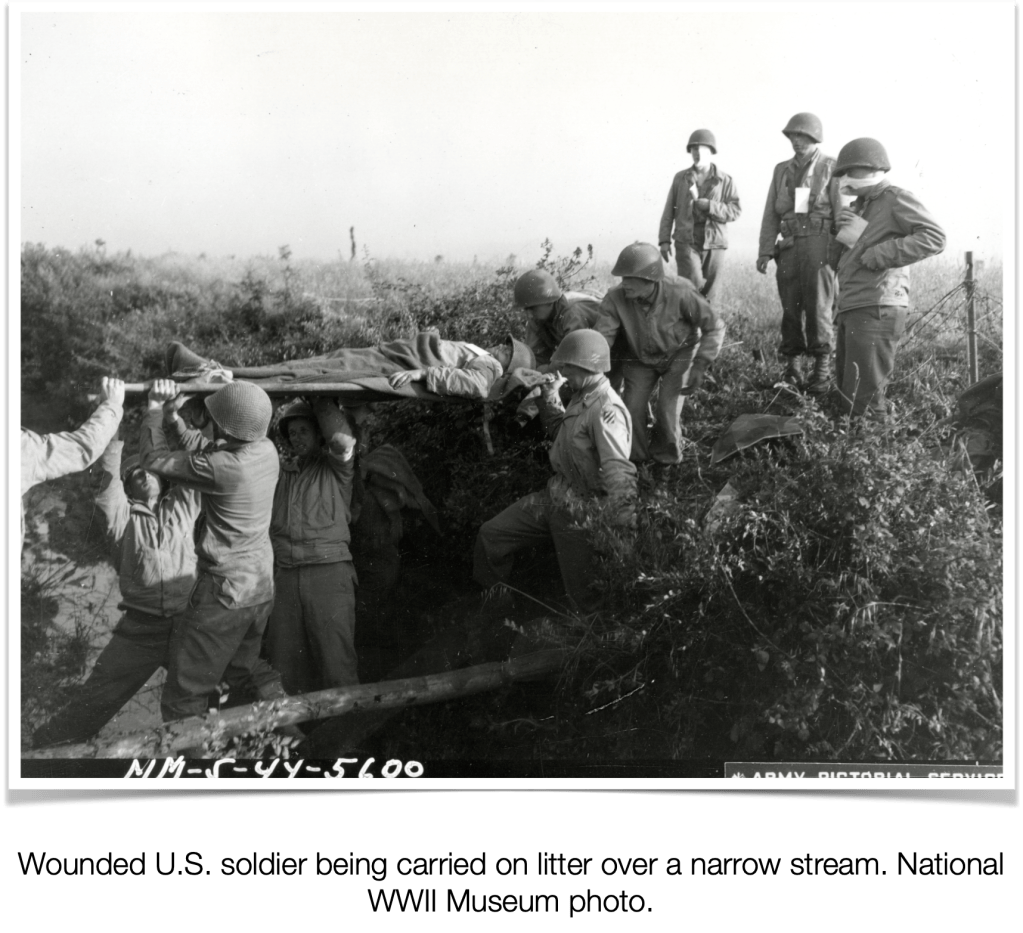
Our artillery finally throws some smoke shells between us and the Germans, and we get back to our lines. At night I stand guard again.13
Thursday, June 1
When I come off guard duty just before daylight, the whole 1st Battalion (several hundred soldiers) was gathering behind the ridge. My company went into the wheat field toward the German lines and dug in, forming a line across the field to give the 1st Battalion support in their attack. I fire my BAR across the field toward the German lines, but do not see any soldiers.
A little after daylight, the 1st Battalion pushed through our defense line and attacked. The Germans start firing immediately. The Germans use snipers, machine guns, mortars, and 20 mm ack-ack guns fired level. I continue firing my BAR until the 1st Battalion soldiers are ahead of me.
The 1st Battalion tries to push forward, but the casualties are very heavy. Another soldier near me is hit and has blood all over his head and body. There is so much blood that I can’t tell how bad he is hit. The field medics carry him out by fireman carry. His legs appear broken. Up in the day, it is apparent that the attack is successful, so my squad is pulled back behind the ridge. The field medics are busy all day and they bring the wounded right by us and there were many of them.14 In the evening, we advance to the Rome railway station. Much destruction there to the boxcars and train tracks. The tracks were twisted and broken from bombs that were dropped by the Americans.
Next: The Advance Through Rome >>
Footnotes:
- Preparations were underway on May 21-22 for “Operation Buffalo,” the Allied attack to breakout of the stalemate, and the 3rd Infantry push toward the German held town of Cisterna. There were likely a lot of messages being couriered to various CPs. ↩︎
- At 5:45 am on May 23, a tremendous Allied artillery barrage was directed against the enemy defenses along the Cisterna front. Anzio Beachhead (22 January-25 May 1944) ↩︎
- As the attack continued on May 24, the 30th and 15th Infantry on each flank bypassed and encircled Cisterna. ↩︎
- The 5-in-1 provided the needs of five soldiers in a single ration package. ↩︎
- The main rail line between Rome and Naples ran through Cisterna’s train station. ↩︎
- U.S. WWII Hospital Admission Card Files record Chambliss’ death in June, 1944 from “Artillery Fragments.” The files cite Crider as being wounded in May, 1944, “Causative Agent: Bullet, Machine Gun.” He was discharged in June. I corresponded with Crider’s daughter in June, 2023, and she corroborated his being wounded as Dad described. Exactly when Boatwright is killed is uncertain. He is reported missing “since May 21.” I have been unable to find any records on Red Hendricks. ↩︎
- Halazone tablets with hypochlorous acid, a powerful oxidizer and chlorinating agent that destroys many organic compounds in water. ↩︎
- The Thompson submachine gun was widely used by the U.S. army during World War II. ↩︎
- A gully. ↩︎
- Lanuvio is a town located about 20 miles southeast of Rome. ↩︎
- Sergeant Elmer V. Fly was awarded four purple hearts, a bronze star, and a silver star for service in North Africa and Italy. He survived the war. ↩︎
- This is most likely Sgt. Ralph Garthwaite from Sheldon, Iowa. Sgt. Garthwaite served in the North African, Sicilian, and Italian campaigns. War correspondent Gordon Gammack wrote about Garthwaite and other Iowa soldiers for the Des Moines Register. A compilation of his articles is available in The 34th Division’s Italian Campaign. Garthwaite survives the war, and returns to Iowa where he joins the highway patrol. He is killed in an auto accident in 1955 while on duty. ↩︎
- At the end of the period (May) the regiment was heavily engaged with the enemy in the vicinity of Lanuvio to the south. ↩︎
- From the Narrative History of the 133rd Infantry: “On 1 June 1944 the regiment continued its attack toward Lanuvio. The enemy had a well established defense line with well established dugouts and camouflaged gun emplacements. The 3rd Battalion was the point in the assault which progressed slowly against heavy machine gun, mortar, self-propelled artillery, and small arms fire. The 3rd Battalion was relieved by the 1st Battalion and hastily reorganized.” ↩︎
 Diary of an Infantryman